Can one clear plan turn daily choices into lasting market success?
Business strategy means choosing a clear direction and building a roadmap that aligns planning with measurable goals.
This guide moves from definition to execution. It frames strategy as a real-world discipline for leaders, managers, founders, and functional owners.
Readers will learn frameworks for value creation, the value stick, levels of strategy, planning inputs, and implementation metrics.
Later sections show why competitive advantage—not mere activity—drives a successful business in the US market.
The article signals practical, EEAT-aligned guidance and real examples to improve decision quality at every company level.
Use this guide by skimming frameworks first, returning for templates and tables, then applying the lessons in a planning cycle.
Why Business Strategy Matters for a Successful Business in Today’s Market
Having a defined direction helps leaders turn decisions into measurable progress. A clear roadmap keeps teams aligned, reduces wasted time, and drives repeatable growth.
Roadmap for decisions and alignment
A shared plan prevents silos by giving managers a common reference for priorities. When teams know the direction, they choose actions that compound instead of conflict.
Leader levers: pricing, suppliers, hiring, resources
Leaders influence price points, vendor choices, hiring practices, and capital allocation through clear choices. These are not isolated department calls; they shape customer value and long-term margins.
Short-term wins vs long-term viability
Opportunistic deals can boost revenue now but often create rework later. A repeatable approach builds a defensible position in a changing market and protects scarce resources and time.
- Consistency reduces firefighting and improves focus on critical goals.
- Aligned choices compound into sustainable competitive advantage.
- Measurable checkpoints keep employees and customers on track.
| Focus | Short-term outcome | Long-term outcome |
|---|---|---|
| Pricing | Quick sales spikes | Margins that support reinvestment |
| Hiring | Fill immediate gaps | Build capability and culture |
| Resource allocation | Reactive spending | Priority funding for growth |
Next: the article will offer practical frameworks for trade-offs and execution, not just high-level ideas.
What Is Business Strategy? Definition, Scope, and Core Outcomes
A clear set of choices defines how an organization turns potential into lasting market value.
A practical definition
Business strategy is an integrated set of decisions and actions aimed at creating measurable value and competitive advantage. It is not a static document. It guides which opportunities the company will pursue and which it will decline.
Why value comes first
Value design must precede making products or offering services. Execution alone cannot rescue an offering that lacks built-in value for customers.
Thinking about value first forces trade-offs and clarity about who benefits and why.
The three value questions leaders should answer
- How will this create value for the customer and meet a real need?
- What value will it deliver to employees so talent, retention, and capability grow?
- How will suppliers and partners gain enough to cooperate without eroding margin?
| Core outcome | How to measure it |
|---|---|
| Value created | Willingness to pay, NPS |
| Margin and retention | Gross margin, churn |
| Capability and defensibility | Time-to-market, ROIC |
The real difference a plan makes is visible in stakeholder outcomes, not internal activity. Leaders should test whether their approach changes daily choices or only sounds good on paper.
Business Strategy vs Business Plan vs Business Model (and Why the Difference Matters)
Clarity about what each planning artifact does prevents wasted effort and internal friction.
Why the difference matters: confusing a master direction with an execution plan or a revenue model creates misaligned work and noisy meetings. Leaders must choose first, then map how the choice turns into timelines and revenue logic.
How they relate
The master direction defines trade-offs and long-term positioning. A plan breaks that direction into tasks, dates, and owners. A model explains how the company creates and captures value.
Where mission, vision, and values fit
Mission, vision, and values act as guardrails. They guide choices but do not substitute for concrete commitments about markets, pricing, or resource allocation.
Quick comparison
| Artifact | Purpose | Typical deliverables |
|---|---|---|
| Master direction | Set competitive choices and long-term direction | Positioning, target segments, win criteria |
| Execution plan | Translate choices into timelines and tasks | Roadmap, milestones, owners, budgets |
| Revenue model | Show how value becomes cash | Pricing, cost structure, unit economics |
- Red flags: a plan of tasks with no positioning choices; a model with revenue numbers but no direction.
- Use the artifacts in order: set direction, validate the model, then build the plan during annual planning.
“Clarity, accountability, and auditability make strategic decisions approvable and actionable.”
Strategy vs Tactics: Turning Direction Into Action Without Losing Focus
A clear plan only helps if each tactical move proves it moves the needle.
Define tactics: tactics are concrete actions teams take — campaigns, supplier negotiations, or operating changes — that should ladder up to a larger plan.
Real examples show the difference. A marketing campaign that targets premium buyers can lift willingness to pay. A supplier negotiation that lowers unit cost can widen margins. An operations tweak that cuts lead time improves customer retention.
Busy work starts when groups measure tasks instead of outcomes. That creates firefighting, lost focus, and low morale over time.
- Each tactic must map to an objective, a metric, an owner (managers/team), and a review cadence on the roadmap.
- Evaluate trade-offs by asking: what to stop, what to double down on, and what requires a time-limited test.
- One-step test: if a tactic cannot state the outcome it changes and the metric that proves it, it likely is not strategic.
Final note: good tactics amplify a solid business strategy; poor tactics can sink even strong plans. Leaders should keep decisions tight, measurable, and time-bound.
The Value Stick Framework: The Fastest Way to Understand Competitive Advantage
Mapping value with four clear levers reveals where a company actually creates advantage.
The value stick is a compact tool to show who benefits from every choice: customers, the firm, suppliers, and employees.
Four components and what they mean
Willingness to pay (WTP) — the max a customer will pay. Raise it with differentiation, brand trust, or better experience.
Price — what the firm charges. It sits between WTP and cost and shifts outcomes immediately.
Cost — unit economics. Lowering cost improves margin without harming customer value when done smartly.
Willingness to sell (WTS) — the minimum suppliers or employees accept. Lowering WTS can come from longer contracts, better roles, or improved benefits.
How to measure outcomes
Customer delight = WTP − price. Practical levers: product features, service quality, and clearer positioning.
Firm margin = price − cost. Watch ROIC as the performance lens: Return on Invested Capital = NOCAT / Invested Capital.
| Component | What to improve | Examples of strategic actions |
|---|---|---|
| Willingness to pay (WTP) | Perceived value, trust | Improve UX, premium packaging, targeted branding |
| Price | Pricing architecture | Tiered pricing, value-based offers, promotions with limits |
| Cost | Unit cost, efficiency | Supplier consolidation, process automation, redesign for manufacturability |
| Willingness to sell (WTS) | Supplier/employee surplus | Long-term contracts, better pay bands, training and career paths |
Note: balanced moves create lasting advantage. Squeezing suppliers or employees may boost short-term margin but harms quality, retention, and long-term value.
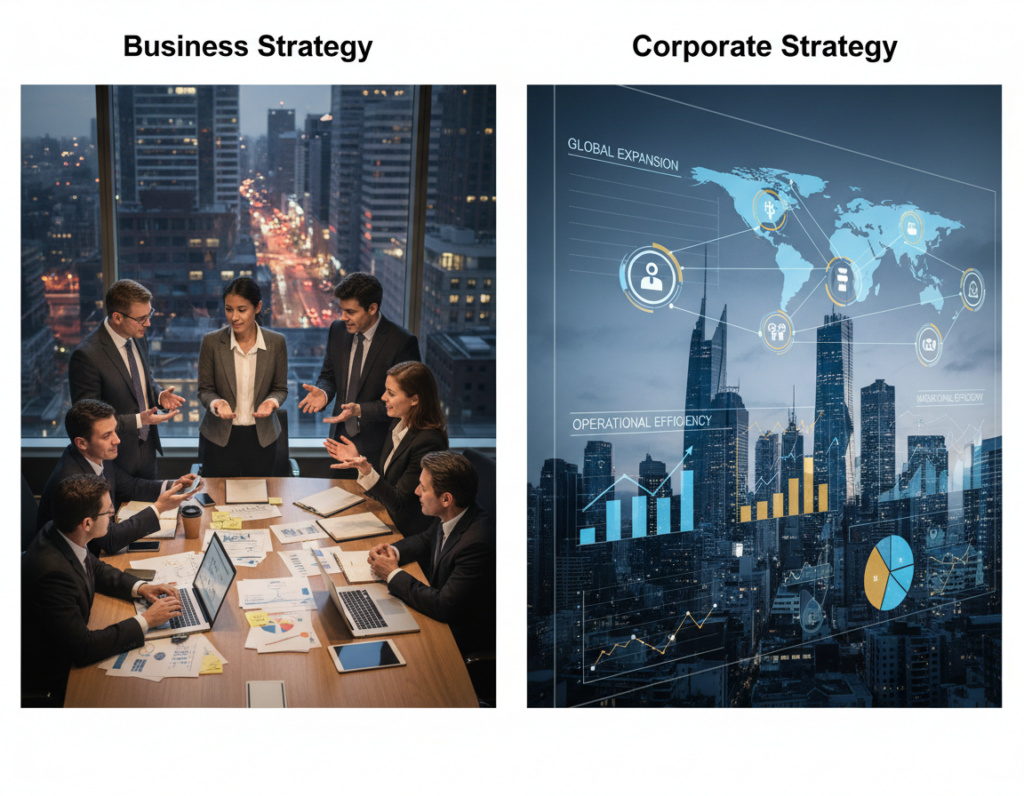
Levels of Strategy in an Organization: Corporate, Business, and Functional
Organizations operate across three decision layers that must link intent to daily work.
Corporate level covers portfolio choices, growth direction, diversification, and mergers or investment moves that shape long-term growth and risk. These are the decisions about where the firm plays and which markets to enter or exit.
Business-level defines how a firm competes in a specific market. It clarifies the customer, the value delivered, and the approach that sustains advantage against rivals.
Functional level translates higher choices into operational decisions across marketing, operations, finance, HR, and R&D. These actions allocate resources, set standards, and measure performance.
- Misalignment across these levels is a common cause of failed execution.
- When priorities, funding logic, or talent do not match, teams pull in different directions.
Alignment checklist for management: consistent positioning, shared priorities, clear funding rules, and talent assignments tied to outcomes.
Clarifying which decisions belong at each level reduces team conflict and speeds execution. For a practical framework on these three tiers, see levels of strategy.
Setting Vision, Goals, and Objectives That Guide Decisions Over Time
A clear vision turns long-term intent into everyday choices that move a firm forward.
The vision states where the organization wants to sit in the market and why that position matters. It must describe a target market position, the intended customer benefit, and a time horizon that guides decisions.
Goals translate vision into priorities. They name what matters most this year. Objectives make goals measurable and time-bound, so each team has a roadmap to follow.
Defining useful objectives
Practical criteria: objectives should be realistic, measurable, and aligned across teams. Each objective needs a clear owner, a metric, and a deadline.
- Realistic — achievable with current resources and clear trade-offs.
- Measurable — tied to a single metric (market share, retention, margin).
- Aligned — supports the same focus across teams and managers.
Good vs weak examples
Good: increase market share in the Northeast by 4 percentage points and improve gross margin by 2 points within 12 months.
Weak: grow rapidly in new markets without specifying where, by how much, or who will measure success.
| Level | Example objective | What it prevents |
|---|---|---|
| Corporate | Reach 15% market share in premium segment by Q4 | Scattered product launches |
| Team | Improve net retention to 92% in 12 months | Short-term acquisition chasing |
| Functional | Raise gross margin 2 points via supplier terms | Cost cuts that harm quality |
Managers use objectives to resolve trade-offs and stop scope creep. When teams link targets back to customer delight, firm margin, and employee value, objectives become the practical bridge from vision to repeatable results.
Strategic Planning Inputs: Market Insight, Data, and SWOT Analysis
Good planning starts with the inputs—raw market facts that prevent meetings from turning into debates.
Why inputs matter: planning quality depends on prepared research, not the length of the meeting. Clear market and customer data reduce opinion-driven decisions and speed alignment.
Understanding target customers and markets
Document segments, core needs, willingness to pay drivers, and switching costs. Note buyer jobs, purchase triggers, and channel preferences.
SWOT that drives choices
Map internal strengths and weaknesses, then external opportunities and threats. Convert each quadrant into one tactical choice: exploit, shore up, pursue, or mitigate.
Fact-based decisions and pre-work
Bring customer interviews, competitive benchmarks, cohort behavior, unit economics, capacity limits, pipeline health, and top risks. These items make debates evidence-based.
| Input | Why it matters | Deliverable |
|---|---|---|
| Customer research | Shows real needs and WTP | Segment profiles, sample quotes |
| Financial data | Reveals unit economics and runway | Baseline margins, ROIC snapshots |
| Market trends | Identifies near-term opportunities | Trend brief with growth estimates |
| Operational constraints | Limits feasible initiatives | Capacity and risk register |
Disciplined steps: assign owners, set one metric per input, and use a prespecified tie-breaker for conflicting data. Repeating this pre-work each year improves learning and development.

Building a Sustainable Competitive Advantage: Positioning, Resources, and Differentiation
Durable advantage springs from clear choices and capabilities that multiply as competitors respond.
Where to play: choose segments with unmet needs, defensible switching costs, or rapid growth potential. Use customer interviews, cohort data, and market trends to exclude options that dilute focus. Picking fewer, clearer targets makes follow-through possible.
How to win
Decide between differentiation and cost leadership, or combine them selectively. Brand and technology act as levers when they support the core choice.
For example, technology can lower cost-to-serve or enable unique experiences. Brand multiplies perceived value when product execution is consistent.
Resource allocation as action
Allocate people, time, capital, and capabilities to the highest-impact projects. Constraints force trade-offs and reveal the real plan.
Track investments by expected impact on customer value and margin to keep funding aligned with outcomes.
Capability development
Build process, data, distribution, and product excellence that compound over development cycles. Small, repeated improvements in these areas create durable edges.
Suppliers and partners
Collaborate to lower willingness-to-sell without eroding margins. Examples: long-term contracts, shared forecasting, and co-marketing that grow demand for both parties.
These approaches create mutual value while protecting margin and quality.
Final point: an effective plan is a portfolio of reinforcing choices. When positioning, resources, capabilities, and partners work together, growth becomes sustainable and defensible.
| Choice | What it commits | Key metric |
|---|---|---|
| Where to play | Target segments and channels | Segment margin and growth rate |
| How to win | Differentiation or cost focus | Willingness-to-pay gap or unit cost |
| Resources | People, capital, time allocation | ROIC and time-to-impact |
| Partners | Supplier terms, joint programs | Supply reliability and joint revenue |
Implementation: Converting Strategy Into a Clear Plan, Timeline, and Team Execution
Clear implementation links the big-picture choice to assigned owners, timelines, and measurable checkpoints.
Translate the direction into a roadmap by listing goals, owners, deadlines, and key dependencies. The roadmap must also say what the organization will stop doing so teams understand trade-offs.
KPIs and performance management cycles
Select a small set of KPIs per objective that show customer impact, margin, and throughput. Run weekly standups for risks, monthly reviews for progress, and quarterly audits for outcomes.
Budgeting and resource planning
Make funding decisions explicit: fund the top initiatives, pause low-impact pilots, and publish a resource scoreboard so allocation is auditable.
Monitoring, learning, and adjusting
Use short learning loops: test, measure, adjust. Limit course corrections to evidence-driven changes to avoid constant second-guessing.
Measuring outcomes
Report ROIC and profit metrics for the firm. Track market share and brand indicators to gauge demand and competitive position.
| Function | KPI | What it signals |
|---|---|---|
| Marketing | Qualified lead rate | Demand quality and channel fit |
| Sales | Conversion rate | Go-to-market effectiveness |
| Operations | Cycle time | Delivery reliability and cost |
| HR | Retention of key roles | Talent stability and capability |
| Finance | ROIC | Return on funded initiatives |
Practical rollout cadence: approve, publish the roadmap, assign owners, start weekly checkpoints, then review quarterly. Discipline wins more than enthusiasm.
Real-World Business Strategy Examples and What They Teach
Concrete company examples reveal how clear choices create lasting advantage.
Creating new demand: HubSpot’s inbound playbook
HubSpot built demand by educating buyers with free resources and certifications. That moved willingness to pay by making marketing teams prefer HubSpot’s tools.
Product differentiation: Apple’s iOS simplicity
Apple chose product focus: a simple, controlled OS that reinforces brand and premium pricing. The trade-off is less openness but stronger customer loyalty.
Employee value creation: compensation and benefits
Gravity Payments raised its minimum wage and gained retention, PR, and productivity gains. Remote work and four-day weeks can also boost performance when paired with clear metrics.
What these examples teach: focus costs something. Each choice affects customer value, margin, and supplier or employee willingness to sell.
| Example | Main choice | Value impact | Measurable outcome |
|---|---|---|---|
| HubSpot | Educate market (inbound) | Higher WTP, more leads | Lead growth, conversion rate |
| Apple | Simple, controlled OS | Stronger brand premium | Price premium, retention |
| Gravity Payments | Higher wages | Lower turnover, better output | Retention rate, revenue per employee |
Practical takeaways: invest where value gaps exist, stop undifferentiated efforts, and measure WTP, cost, and retention to judge success.
Conclusion
Lasting advantage comes from coordinated choices, not scattered activity or bright ideas. Business strategy is a core system of choices that guides an organization toward durable success.
Start with mission, vision, and values, then translate that direction into planning, goals, and clear actions. Use the value stick as a core tool to test whether moves increase value for the customer, employees, and the company.
Immediate next steps: clarify vision, set measurable goals, run a SWOT, define where to play and how to win, and assign KPIs. Treat strategic planning as ongoing—test, measure, and iterate on evidence rather than intuition.
Focus and disciplined execution, not ideas alone, make growth and opportunity capture real.